Blog
September 2026 Market Update: A Landscape Full of Neutrals

Summer Chop (suey)
What an eventful and uneventful summer it has been in the stock market. We have continued to have ‘war on/ war off’ news and consequently better or worse inflation expectations. We have also experienced continued fear and greed around the AI revolution and the uncertainty of returns on the trillions being spent to build out the necessary infrastructure. There has even been a technical correction of just over -10% in the Nasdaq from early June to the end of July. For as eventful as the headlines have been – and not without extraordinary volatility – the broad stock market indices have traded sideways since early May, or five months of relentless chop. Still, that’s not to say stocks have had a bad year. In fact, both major indices, the S&P 500 and the tech-heavy Nasdaq, are both up approximately +13% and +14%, respectively, year-to-date, although most of that return occurred after the March sell-off and subsequent recovery in April and May. Bonds, by contrast, are having a terrible year having lost -3% of their value.
While frustrating, and this has been the choppiest market we have seen in quite some time, this is relatively typical stock market behavior after a sharp drawdown and violent rally. As they say, the market has been consolidating and digesting the previous +20% rally in the S&P 500 off the bottom. Choppy markets can be especially tough to trade, particularly for our strategy, as we like to see trending assets, and that is not what the field has given us. Assets have routinely started to trend higher and then get smashed back down, only to repeat the cycle again. In this environment, the goal is to continue to manage our positions and overall exposure such that we are on the right side of the next big move. And as we are already some five months into this action, we believe there will be resolution sooner rather than later.

The Dovish-Hawkish Tug-of-War
Outside of the Iran War – which we are not going to comment on here, due to the how quickly the headlines change – the real story of the summer has been the dovish and hawkish developments at both the Treasury under Scott Bessent and the new regime at the Federal Reserve under Kevin Warsh. Recall, dovish policy equates to looser monetary conditions which typically is favorable to financial assets like stocks and precious metals, while hawkish policy is just the opposite. Since the end of July, there have been four major developments which we will briefly outline here:
1. During the July 28-29 Federal Open Market Committee (FOMC) Meeting, the Fed voted 9-3 to keep interest rates unchanged, matching market expectations. However, three regional presidents broke ranks to demand an immediate rate hike. It is atypical that this many regional presidents voted against Chairman Warsh which dubbed the meeting the ‘Family Fight.’ With this many dissidents demanding a hike and Chairman Warsh largely fumbling the press conference to defend his rationale to hold rates steady, the market subsequently sold off sharply to price in future rate hikes. This was decidedly hawkish and bad for financial assets.

2. On July 30, in response to a strengthening US Dollar (arising from the aforementioned hawkish comments/ anticipated tightening of US monetary policy), the Japanese Yen was collapsing to 40-year lows relative to the dollar. In short, for many years now, global financiers have borrowed cheap yen and invested in higher yielding financial assets such as US tech stocks (known as the ‘global carry trade’). A continued slow decline of the yen is good for this trade, but it suddenly collapsed due to the Hawkish Fed which caused panic in the Japanese economy as it took too many yen to import goods to the island (i.e. inflationary for Japanese locals). At this point, the Japanese had to step in and defend the yen which then caused the yen to spike. The spike in yen caused the global financiers to have to then liquidate their US tech stocks to close out their borrowing in yen which was going against them. US stocks were falling dramatically at the end of July because of this, and Treasury Secretary Bessent intervened in a complex way (the exact mechanics too complicated for this short summary). The result was stabilization of the yen and stabilization of the carry trade such that the forced selling of US stocks ended. The US Dollar also sold off around -2%. This was decidedly dovish as the US supported a foreign currency to effectively weaken the dollar and strengthen US stocks and precious metals.
 3. On August 19, Bessent announced the Treasury would double the size of its long-term bond buyback program from $2 billion per month to at least $4 billion per month beginning in September. Here, he is effectively using taxpayer dollars to issue short-term debt to retire longer-term Treasurys. As we mentioned earlier, bonds are having another terrible year with the average bond down around -3%. We know that bonds have an inverse mathematical relationship to interest rates, such that when interest rates go up, bond prices go down. The 10 year US Treasury yield started the year around 4.18% and has since appreciated dramatically to approximately 4.80% today on the heels of inflation expectations and rate hike comments from the Federal Reserve. Effectively, Bessent is playing defense to try and put a lid on higher interest rates. While $4 billion per month is probably not enough to have a dramatic effect on managing long-term interest rates, this is a significant signpost that they are probably willing to do more. The net effect is decidedly dovish and constructive for stocks, bonds, and precious metals.

4. Most recently, the Fed concluded their annual Economic Symposium at Jackson Hole on August 28th. Chairman Warsh kept up with his frank comments and lack of forward guidance (as he previously promised) but was notably hawkish is his keynote address, emphasizing that the Fed “has work to do” if inflation trends fail to improve with sufficient speed. Again, this is decidedly hawkish for stocks and precious metals and the Nasdaq sold off approximately -2% after his press conference.

The Show Goes On
While the mechanics of the four recent developments from the Fed and Treasury are admittedly complex, the theme is clear: the Treasury, directly under the purview of the White House, is dovish and willing to support easy monetary conditions beneficial for stocks and precious metals. Meanwhile, the Fed, apparently independent of the White House, is hawkish and willing to tame inflation at the expense of stocks and precious metals. After today’s strong jobs report, the stock market was fairly weak as this makes it harder for the Fed to raise interest rates. The market is now pricing in a 60% chance of a 0.25% interest rate hike at the next FOMC meeting in mid-September. Of course, how this all nets out is undecided and a large reason why the market has chopped around all summer.
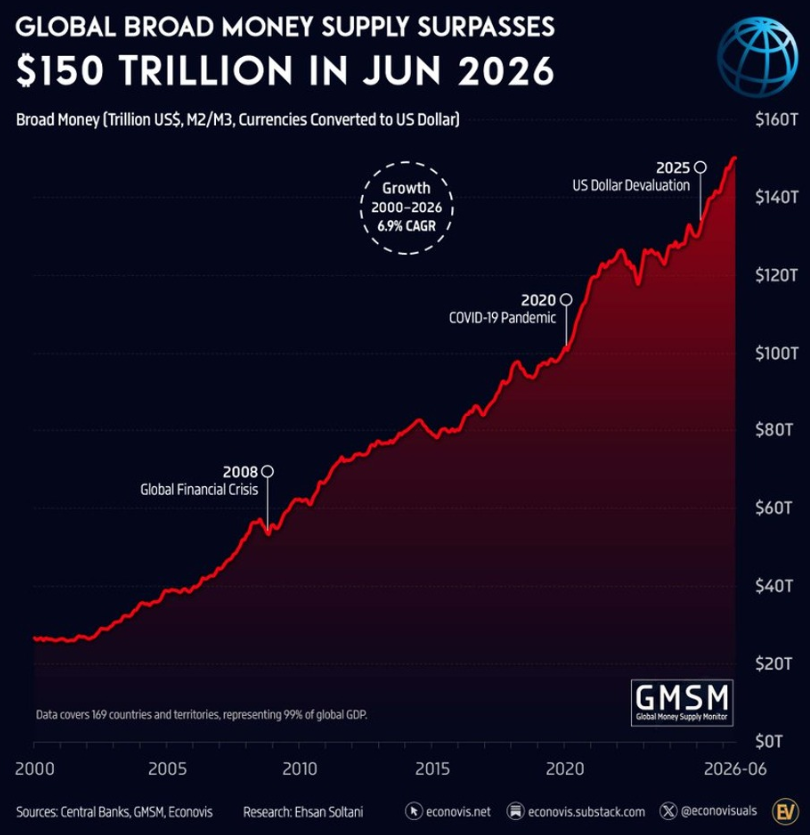
What we do know is that the Treasury is dovish, and while the Fed is talking tough about raising interest rates, the Fed is also still printing money to buy bonds (i.e. Quantitative Easing or ‘QE’) which is also dovish as it is supportive of lower long-term interest rates. Recall, Powell restarted QE in December after having stopped for over the last three years concluding that program in March 2022. In fact, as the Kobeissi Letter points out, global broad money supply surged +$10.7 trillion year-over-year in June, or +7.7%, to a record $150 trillion (below). Since 2000, global money supply has risen +$124 trillion, a +6.9% compounded annual growth rate over this period; therefore, recent growth has been higher than the average rate since 2000. So, global money creation is still expanding at a historic rate. This is the machine the grinds in the background supportive of stocks and precious metals. The only hiccup is the short-term question about the Fed raising interest rates. Precious metals, which were destroyed earlier this year because of the hawkish Fed talk, have woken up after Bessent intervened in yen market and in the US Treasury market. Gold is up around +10% since then and we have reallocated some funds to the precious metals space. While we are not wedded to this investment as the anticipated rate hike could sour this thesis, we are positioning to be on the right side of the next big move.